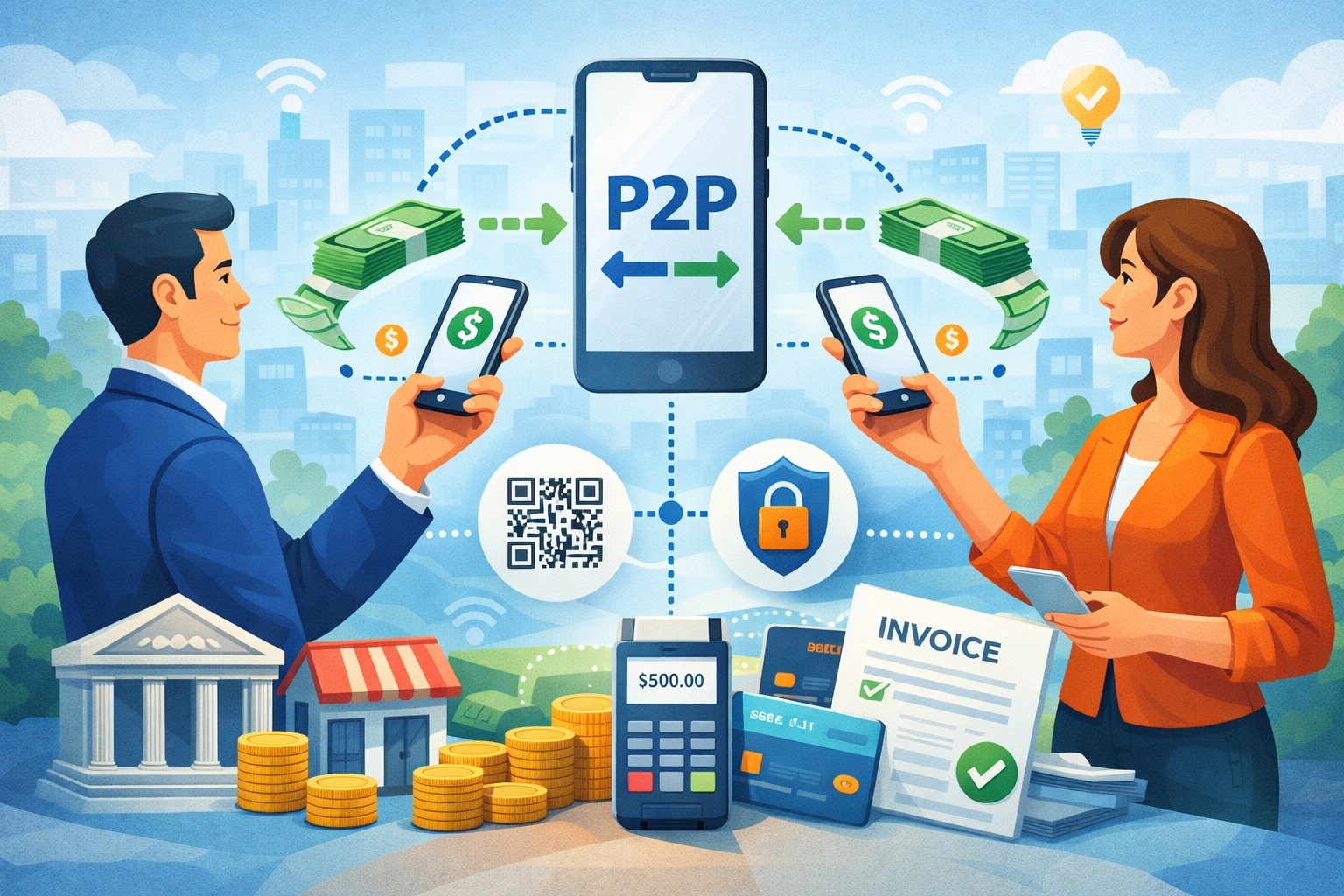
P2P business payments are the modern “send money instantly” experience—adapted for real commerce. Instead of waiting days for a transfer or chasing checks, you can accept or send funds using a phone number, email address, QR code, or in-app identity, with money landing in a bank account or digital wallet faster than traditional methods.
For many small operations, P2P business payments feel like the quickest path from “customer paid” to “cash available.”
But there’s an important shift happening: what started as casual peer-to-peer transfers is now powering real workflows—customer checkout, deposits, invoice collection, tips, contractor payouts, and even some vendor payments.
In other words, P2P business payments are no longer just a convenience feature. They’re becoming part of a business’s payment stack.
At the same time, P2P business payments come with trade-offs: fees, limits, dispute rules, fraud exposure, recordkeeping needs, and platform restrictions on certain industries.
Choosing the right approach means understanding how P2P business payments actually move, what “instant” really means, how to keep your books clean, and how to reduce risk without killing conversion.
This guide explains P2P business payments in plain language, gives practical use cases, and shows how to implement P2P business payments in a way that scales.
You’ll also find future-facing predictions—because the next wave of P2P business payments is being shaped by real-time bank rails, request-for-payment messaging, richer remittance data, and more automation.
Defining P2P Business Payments and Why They Matter
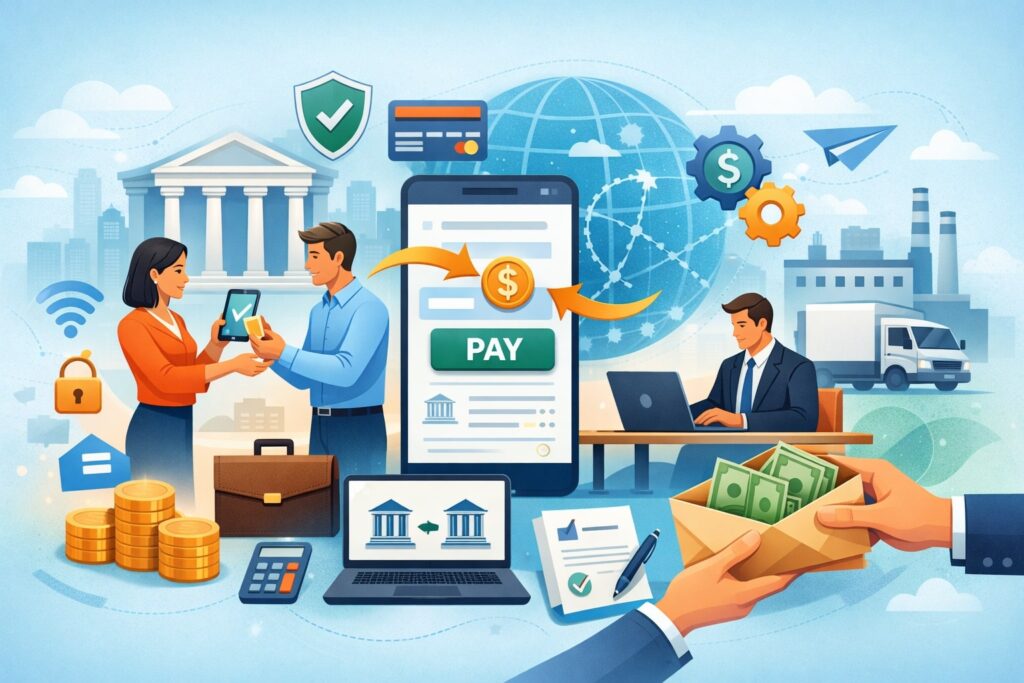
P2P business payments are person-to-person style transfers used for business purposes—either customers paying a business, or a business paying individuals and other small operators.
The defining characteristic is the user experience: fast setup, identity-based sending (phone/email/handle), and a lightweight checkout flow that often happens inside an app or bank interface.
In practice, P2P business payments sit between “formal merchant payments” (card-present, online checkout gateways, invoicing platforms) and “bank transfers” (ACH or wire). They’re designed to reduce friction.
That matters because friction kills sales: if a customer has to find a checkbook or type a long account number, many simply won’t pay right then.
P2P business payments matter most for small businesses that need speed and simplicity: solo providers, appointment-based services, local sellers, market vendors, creators, and side hustles.
They also matter for businesses that pay people frequently—like property managers paying maintenance, agencies paying freelancers, or retailers paying hourly workers and temporary staff.
The reason P2P business payments have accelerated is simple: customers already use these apps. When buyers can pay in two taps, businesses get paid faster, cash flow improves, and “time to close” shrinks.
And when payments land quickly, businesses can restock, cover payroll, and invest in marketing without waiting on settlement.
Still, P2P business payments shouldn’t be treated as “just another button.” If you’re collecting money for goods and services, you need the right account type, the right records, and the right safeguards.
That’s the difference between P2P business payments that help you grow—and P2P business payments that create headaches later.
P2P Business Payments vs. Traditional Business Payment Methods
Traditional business payments usually run on established rails with well-defined roles: merchant, acquirer, processor, issuing bank, and card network—or bank-to-bank rails like ACH and wire. These systems are predictable, auditable, and designed for commerce, but they often involve more setup and more steps for the payer.
P2P business payments change the “front end” dramatically. Instead of asking for card details or bank routing/account numbers, P2P business payments often use a simple identifier (email, phone, handle). That simplicity reduces checkout drop-off and speeds up collections. In many cases, the payer already has the app installed and a funding source linked.
Speed is another key difference. Some P2P business payments feel instant because the platform front-runs the experience, while the back-end settlement can vary. In contrast, card payments can authorize instantly but settle later; ACH can be same-day or next-day; wires can be same-day but cost more.
Risk and disputes differ too. With cards, chargebacks and dispute frameworks are standardized. With P2P business payments, disputes can depend on the platform’s rules and whether the payment was sent to a personal profile or a business profile. That’s why businesses need to implement P2P business payments intentionally, not casually.
Finally, reporting is often easier with traditional merchant tools. Many P2P business payments tools are improving here, but businesses still need to plan for reconciliation, receipts, and tax documentation if they want clean books and fewer surprises.
What Counts as “Business” When Using P2P?
A P2P payment becomes a P2P business payment when it’s tied to commercial activity: selling goods, charging for services, collecting deposits, taking tips connected to work performed, or paying contractors and workers. Even if the transfer looks like a casual “send money,” the purpose matters.
This distinction matters because platforms often have specific rules about business use. Some allow business profiles or business enrollments; others restrict certain categories or require additional verification.
Using a personal account to accept business money can trigger limits, account freezes, tax reporting complications, or loss of protections that apply to business profiles.
From an operational viewpoint, P2P business payments should be treated like any other revenue stream. That means: tracking who paid, why they paid, what it covered, and when it was delivered. If you can’t answer those questions quickly, P2P business payments become messy during refunds, disputes, and tax time.
A practical way to decide if a transfer is truly a P2P business payment is to ask: “Would I issue a receipt for this?” If yes, it should be handled as a P2P business payment with proper records.
Another test: “Would I recognize this as income in my accounting software?” If yes, you need a consistent labeling system, even if the platform doesn’t provide robust invoice metadata.
The bottom line: P2P business payments aren’t “informal money.” They’re real business payments with real responsibilities—and when handled correctly, they can be one of the fastest ways to improve cash flow.
How P2P Business Payments Work End-to-End
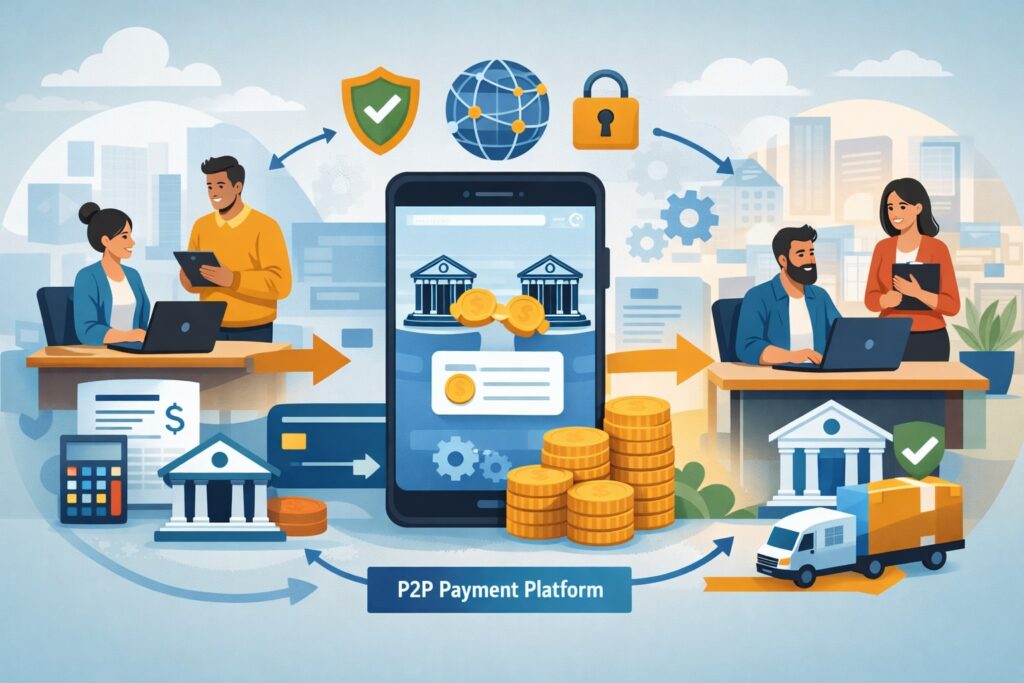
Even though P2P business payments feel simple, there’s a lot happening behind the scenes. Understanding the mechanics helps you choose the right tool, set expectations with customers, and reduce risk.
At a high level, a P2P business payment has five stages: initiation, authentication, funding, movement/settlement, and posting/availability. The customer initiates the transfer using an identifier (phone/email/QR).
The platform authenticates the user, checks risk signals, and confirms the recipient. Then it funds the transfer—either from a linked bank account, a stored balance, a debit card, or sometimes a credit card.
After that, the platform moves funds across its internal ledger or through bank rails. Finally, the recipient sees the payment, and the funds become available depending on the rail and platform rules.
This is why “instant” can mean different things. In some systems, the notification is instant but funds availability can vary. In other systems, real-time rails deliver both immediate confirmation and immediate availability.
Modern P2P business payments increasingly aim for “confirm + settle” in one flow—especially as real-time bank-to-bank infrastructure expands.
For businesses, the operational takeaway is that P2P business payments are not one single technology. They’re a family of experiences layered on top of different funding sources and rails. Your job is to match the experience to your business model.
Funding Sources: Bank Account, Debit, Credit, and Wallet Balances
P2P business payments can be funded in multiple ways, and each funding type affects fees, speed, and risk. Bank account funding often has lower cost but can be slower to settle depending on the underlying rail.
Debit card funding can be faster and more predictable, but it may carry different fee structures. Credit card funding can be convenient for the sender, but it often increases cost and can change dispute dynamics.
Wallet balances—money already stored inside an app—can make P2P business payments feel instantaneous because the platform is essentially moving funds internally. The “real” settlement happens later when the wallet is topped up or withdrawn, but the user experience is immediate. This can be helpful for small payments, tips, or rapid transactions.
From a business perspective, it’s important to decide whether you want to accept all funding types or restrict some. If you’re trying to keep P2P business payments inexpensive, you may prefer bank-funded flows.
If you prioritize speed, you may allow debit-funded flows. If you accept credit-funded payments, you need to be more thoughtful about pricing and refunds.
In day-to-day operations, funding choices affect customer behavior. Some customers will only pay if they can use a card. Others prefer bank transfers. The best P2P business payments setup gives customers at least one low-friction option while protecting your margins and keeping your accounting clean.
Settlement, Availability, and What “Instant” Really Means
Businesses adopt P2P business payments largely for speed. But speed has layers: speed of confirmation, speed of availability, and speed of finality. Confirmation is the “payment sent” message. Availability is when you can actually use the funds. Finality is the point when the payment is irreversible under normal rules.
Some P2P business payments systems provide instant confirmation but delayed availability, especially when risk flags appear or when transfers rely on slower rails in the background. Other systems deliver near-instant availability because the platform advances funds or because the payment runs on real-time bank rails.
Real-time networks are pushing the industry toward true instant settlement. For example, the Federal Reserve has emphasized that instant payment infrastructure can support use cases like bill pay and account-to-account transfers, and it includes features like request for payment and remittance information to support a variety of scenarios.
Availability also ties to limits. Higher limits often come with stronger risk controls and, sometimes, additional verification. Your business policies should reflect this: for high-ticket items, you may need a different payment method or a different P2P business payments flow than you use for low-ticket items.
The practical approach is to define categories: what you’ll accept via P2P business payments instantly, what you’ll accept with a waiting period, and what you’ll route through more formal rails. That way, P2P business payments remain a growth tool rather than a risk magnet.
Major Options Businesses Use for P2P Business Payments Today

There isn’t one single “best” P2P business payments platform. The right choice depends on your customers, your average ticket size, your risk tolerance, and whether you need commerce-grade features like receipts, itemization, dispute handling, and exportable reports.
Most P2P business payments options fall into two buckets: bank-based P2P and app-based P2P. Bank-based P2P often integrates directly into online banking. App-based P2P is typically a standalone app with a wallet and social-style transfers.
Many businesses use more than one option. That’s normal. Your customers may strongly prefer one app over another, and the fastest path to getting paid is often “meet customers where they already are.” The key is to avoid chaos by standardizing your processes: naming conventions, receipt messages, reconciliation, and refund rules.
Bank-Based P2P Business Payments
Bank-based P2P business payments are appealing because they often deposit directly into your bank account and can feel “native” to banking. A common example is bank-offered P2P that lets businesses send and receive payments using an email address, mobile number, or tag, with funds received directly in the account through the bank’s digital channels.
For businesses, the advantages include fewer moving parts, clearer banking relationships, and sometimes better alignment with treasury tools. Bank-based P2P business payments can work well for service businesses that want a simple “pay me” option and prefer funds to land directly in their business checking account.
Another advantage is that bank-based P2P business payments can reduce wallet fragmentation. Instead of money sitting in multiple apps, you consolidate cash flow to the bank account you already use for bills, payroll, and taxes.
However, there can be trade-offs. Not every bank supports the same features, and enrollment experiences can vary. Limits may differ by bank. Some customers may not know how to use bank-based P2P, while they’re already comfortable with popular apps.
The best approach is to offer bank-based P2P business payments as a primary option and keep one app-based option as a backup for customer preference.
App-Based P2P Business Payments
App-based P2P business payments are often the fastest to adopt because customers already have the apps and the user experience is familiar. Many platforms now offer business profiles with seller fees that are charged to the merchant rather than the buyer—similar to standard merchant acceptance models.
This approach is particularly useful for micro-businesses: pop-ups, mobile services, and local sellers who want to accept P2P business payments without building a full online checkout. App-based P2P business payments often support QR codes, payment links, and in-app receipts or notes.
But app-based P2P business payments require careful setup. You should use the correct business profile or business enrollment option, not a casual personal profile, because platform policies and protections can differ. Fees can also meaningfully affect margins, especially if your average sale is small and you’re paying per-transaction charges.
Operationally, app-based P2P business payments work best when you standardize the payer note format (for example: “Invoice #, service date, customer last name”) so you can reconcile quickly. Without that, app-based P2P business payments can turn into a scrolling list of ambiguous transfers that are painful to match to orders.
Best-Fit Use Cases for P2P Business Payments
P2P business payments shine when speed and simplicity matter more than complex checkout logic. They’re especially strong when the “moment of intent” is immediate: the customer is ready now, and you want the payment to happen before they get distracted.
That said, not every use case is equal. The best P2P business payments use cases have three things in common: a clear payer identity, a clear purpose for the payment, and a simple refund path if plans change. If any of those are unclear, you may want to use invoicing tools, card acceptance, or bank transfer methods with stronger metadata.
The easiest way to pick use cases is to map your customer journey and find the points where payment friction causes delays. Then insert P2P business payments where they remove friction without increasing risk.
Freelancers, Creators, and Service Providers
For freelancers and service providers, P2P business payments can be a revenue accelerator. You can send a payment link right after finishing work, collect a deposit before you start, or accept partial payments for milestones. This reduces “days sales outstanding” and smooths cash flow.
In service work, speed often beats sophistication. Customers want a simple way to pay without logging into a portal. P2P business payments provide that. You can also pair P2P business payments with lightweight documentation: a simple invoice PDF, a text message summary, or a confirmation email.
A strong workflow is: quote → deposit via P2P business payments → appointment or delivery → balance via P2P business payments → receipt and confirmation. When you standardize that flow, you spend less time chasing money and more time doing billable work.
To keep things clean, define naming rules for payment notes. For example: “ClientName | Service | Date | Invoice#.” The notes become your mini-remittance data. This is one of the biggest differences between casual transfers and professional P2P business payments.
Finally, service providers should set a “threshold.” For higher-value jobs, you may still use P2P business payments, but you’ll want stronger identity verification, clearer receipts, and possibly a contract clause defining refund and cancellation rules.
Retail, Pop-Ups, Field Sales, and Market Vendors
In face-to-face selling, P2P business payments often compete with card readers. For some businesses, P2P business payments can reduce hardware dependence and speed up checkout—especially when customers are already comfortable scanning QR codes or using a favorite app.
Market vendors and pop-ups frequently benefit from offering both: card payments for customers who want traditional checkout, and P2P business payments for customers who prefer app-based transfers. This “choice” can boost conversion and reduce lines.
Field sales and mobile services also benefit. A technician can complete a job, show the invoice, and accept a P2P business payment immediately. This reduces billing cycles and lowers the risk of non-payment.
To do it well, you need three operational habits. First, display your P2P business payments QR code clearly and consistently. Second, confirm the payer’s name or last four digits of a phone number before handing over goods. Third, use short receipts and clear refund policies. A quick message like “Paid—Order #123, pickup confirmed” makes a huge difference later.
P2P business payments can also help reduce cash handling risks at busy events. Less cash on hand means fewer counting errors and fewer safety concerns—another reason these payments have become a go-to option for in-person micro-merchants.
Fees, Limits, and the True Cost of P2P Business Payments
One reason businesses adopt P2P business payments is the belief that they’re “free.” Sometimes they are low-cost, but the real cost depends on the platform, funding source, and account type.
The most expensive P2P business payments setups are the ones that cause accounting chaos, refunds confusion, or lost inventory due to fraud.
You should evaluate cost in four layers: explicit fees, implicit fees (like slower access to funds), operational costs (like reconciliation time), and risk costs (like fraud losses). A platform with a slightly higher fee can still be the better deal if it provides better reporting and clearer business protections.
Limits matter just as much. Limits define what transactions you can realistically process. If your average invoice is above typical limits, you may need to split payments (which is messy) or route large transactions through other rails.
Finally, the economics of P2P business payments are changing as real-time rails expand. Higher-value instant payments are becoming more practical, which will shape pricing and competition across platforms.
Common Fee Models You’ll See
In many consumer-style apps, personal transfers can be free under certain conditions, but P2P business payments are often monetized similarly to merchant acceptance.
For example, business profiles may be charged a seller fee on payments received, and those fees are usually paid by the merchant rather than the buyer.
You may also see instant transfer fees when you move money from an app wallet to your bank account immediately instead of waiting. This is an important hidden cost for businesses that rely on daily liquidity.
Some bank-based P2P business payments options can feel lower-cost because they route funds directly to the bank account and may be priced differently depending on the financial institution’s offering.
To manage fees, many businesses use a hybrid strategy: accept P2P business payments for deposits, tips, and smaller balances, while routing larger transactions through card acceptance or bank transfer options that offer better reporting and predictable settlement.
The key is to track your effective rate. Don’t just look at the advertised fee. Calculate: total fees paid ÷ total revenue collected via P2P business payments. Then compare that to the time saved and the cash flow improvement.
Limits and the Shift Toward Higher-Value Instant Payments
Limits used to keep P2P business payments mostly in the “small ticket” category. That’s changing. Real-time bank rails are expanding capabilities and enabling higher-value use cases for businesses.
Industry reporting in 2025 highlighted that The Clearing House increased its RTP network transaction limit to support larger payments and new commercial use cases, with examples of corporate clients sending higher-value transactions.
On the Federal Reserve side, coverage of FedNow developments has also pointed to higher transaction limits and the potential for more business-related use cases as the network evolves.
Why does this matter for P2P business payments? Because as limits rise, the line between “P2P-style experience” and “serious business payments” blurs. Businesses will increasingly expect instant confirmation, instant availability, and better remittance information—even for larger invoices.
The practical implication: over the next few years, you’re likely to see more P2P business payments tools offering invoice references, richer descriptions, and structured metadata. That will reduce reconciliation pain and make instant payments more attractive for B2B scenarios that previously depended on ACH or wires.
Risk, Compliance, and Fraud: Making P2P Business Payments Safe
Any payment method that’s fast and convenient can also be attractive to fraudsters. P2P business payments are no exception. The best defense is to treat P2P business payments as a formal channel with defined controls, not an informal convenience.
Risk management for P2P business payments includes identity verification, transaction confirmation practices, refund policies, device and account security, and employee training. It also includes compliance basics: using the right account type, keeping proper records, and understanding platform rules for prohibited categories.
The goal isn’t to overcomplicate things. The goal is to prevent the predictable problems: mistaken recipients, fake payment screenshots, social engineering scams, friendly fraud, and disputes where you have limited recourse.
When you design your P2P business payments process, design it around two questions: “How do I prove what happened?” and “How do I avoid shipping or delivering before funds are truly confirmed?”
Common Fraud Patterns and How to Prevent Them
One of the oldest tricks is the fake payment screenshot. A customer claims they paid via P2P business payments and shows a screenshot, but the money never arrived. The fix is simple: only trust your own account confirmation, not a customer’s screen.
Another risk is misdirected payments. A payer selects the wrong contact with a similar name. If you’re using P2P business payments for in-person checkout, confirm the payer’s intended recipient and verify the incoming transaction before completing the handoff.
Chargeback-style risk depends on platform and funding source. Some P2P business payments have limited reversal options once sent; others may have dispute processes. You should set expectations upfront: refunds are processed after verification, and customers should include the correct invoice/order reference.
Social engineering is also growing. Fraudsters may claim urgency, overpay and ask for a refund to a different account, or pressure staff to “just send it back.” Your policy should be: refunds only go back to the original payer and original channel after funds clear.
Finally, strengthen account security. Use strong passwords, enable multi-factor authentication, restrict admin access, and separate business and personal accounts. If P2P business payments are a meaningful revenue channel, treat the login like you treat your bank login.
Recordkeeping, Tax Reporting, and Policy Alignment
P2P business payments are still business income when used for sales or services. That means your accounting needs to capture gross receipts, fees, refunds, and net deposits. The easiest approach is to create a dedicated “P2P business payments” income account in your bookkeeping system and reconcile weekly.
Policies matter because platforms have rules. If you accept P2P business payments through the wrong profile type, you can run into disputes over eligibility for business tools, reporting, or support. Using business enrollment options where available helps align your activity with platform expectations.
You also need consistent customer communication. Your invoice or message should state: what the payment is for, refund terms, delivery terms, and what to include in the payment note. This protects you and makes reconciliation smoother.
If you have employees, define who can accept P2P business payments and how. For example: only managers can approve refunds; staff must verify payment received before completing the sale; all payments must include an order number.
These basics turn P2P business payments into a reliable channel rather than an accounting mystery. And reliability is what helps you scale—because the more volume you process, the more small inconsistencies become big problems.
How to Choose the Right P2P Business Payments Setup
Choosing P2P business payments is less about picking a brand and more about designing a system your customers will use and your back office can handle. The “best” option is the one that matches your buyer behavior, keeps your books clean, and doesn’t expose you to unacceptable risk.
Start by asking how your customers prefer to pay. If most customers already use a particular app, supporting that app can increase conversion. But you should still prioritize business-friendly features: business profile support, exportable reports, clear fee disclosures, and predictable settlement behavior.
Next, map your transactions: average ticket size, peak volume days, refund frequency, and whether you sell goods, services, or both. A service business collecting deposits has different needs than a seller shipping products.
Finally, consider redundancy. Many businesses do best with two options: one primary P2P business payments method and one backup. That way you don’t lose a sale if a customer refuses to use your preferred method.
A Practical Checklist for Selecting a Platform
A strong P2P business payments checklist includes:
- Business eligibility: Can you use a business profile or business enrollment for your category?
- Customer reach: Do your customers already have the app or bank feature?
- Fees and transfer costs: What’s the seller fee, and are there instant transfer fees?
- Limits: Do limits support your average transaction size and seasonal spikes?
- Reporting: Can you export transactions, filter by payer, and track notes reliably?
- Receipts and metadata: Can you attach references that help reconciliation?
- Support and dispute handling: Is there business support, and what’s the dispute path?
- Banking integration: Do funds land directly in your business bank account?
After you pick, write a one-page internal “P2P business payments policy.” Include: accepted methods, verification steps, note format, refund rules, and who is authorized. This small document prevents inconsistent handling across staff and locations.
Then test it with real customers. Ask: Was it easy? Did anything confuse you? Where did you hesitate? The goal is to remove friction while maintaining control.
Implementation Best Practices That Prevent Chaos
Implementation is where most businesses win or lose with P2P business payments. The best practice is to standardize the customer instruction and standardize the internal workflow.
Create a short payment script you can text or email: “Pay using this link/QR. Include your invoice/order number in the note. You’ll receive a confirmation message when received.” This reduces missing information.
Use a dedicated business email and phone number for P2P business payments accounts. This prevents staff turnover and keeps ownership clear. It also reduces the risk of mixing personal transfers with P2P business payments.
Build a reconciliation habit. Daily is ideal for high volume; weekly is acceptable for low volume. Match incoming P2P business payments to invoices or orders and log fees. If you let it pile up, fixing it later costs more time than you saved.
Also, build a refund protocol. Don’t improvise refunds in the moment. Define when a refund is allowed, how it’s approved, and how it’s documented. Customers love P2P business payments because they’re fast—so refunds must be controlled but not painful.
When these basics are in place, P2P business payments become predictable. Predictability is what makes them scalable.
The Future of P2P Business Payments and What to Expect Next
P2P business payments are evolving from “app-to-app transfers” into a broader concept: instant, identity-based payments supported by modern bank rails and richer messaging. The future looks less like a social feed and more like real commerce infrastructure—without losing the two-tap simplicity people love.
One major driver is real-time bank networks and the features layered on top. The Federal Reserve has described instant payment infrastructure as “use-case agnostic” and highlighted request-for-payment momentum—tools that can support consumer and business scenarios.
Another driver is higher-value instant payments. As limits increase and adoption grows, businesses will push more invoice and vendor flows into instant payments. Coverage of RTP limit changes and expanding business use cases reflects this trend.
The net result: P2P business payments will increasingly compete with ACH for certain transactions and with cards for some “pay by bank” experiences—especially when confirmation, remittance, and request-for-payment become common.
Request-for-Payment, Remittance Data, and Smarter Reconciliation
A major weakness of early P2P business payments was missing context: who paid, what it was for, and how to match it to an invoice. The future is structured messaging.
Request-for-payment (RFP) flips the flow. Instead of the customer guessing what to send and when, the business sends a request with an amount, description, and reference. The payer approves and pays, and the business receives a cleaner record. FedNow materials and updates have pointed to RFP as a key feature and a growing area of industry momentum.
As RFP grows, P2P business payments will feel more like invoicing—without the friction of card entry or portal login. Businesses will get better reconciliation because the payment arrives with references and remittance info.
This matters for growth. Better reconciliation reduces back-office cost, which is a hidden barrier for small businesses scaling beyond a few dozen payments per week. When the “what was this for?” The question goes away, P2P business payments become viable for more business categories and more complex operations.
Embedded Finance, AI Risk Controls, and the Next Wave of Experiences
The next wave of P2P business payments will also be shaped by embedded finance: payment options integrated directly into invoicing tools, scheduling apps, marketplaces, and industry software. Instead of sending customers to a separate app, the “P2P business payments” experience will be built into workflows businesses already use.
AI will play a bigger role too—especially for fraud detection and risk scoring. That means smoother approvals for legitimate transactions and stronger blocks for suspicious behavior. Over time, this could reduce account freezes and false positives that frustrate small businesses.
Expect more “choice routing” as well. A single pay button might offer multiple rails behind the scenes—real-time bank transfer when available, fallback to other methods when not. For businesses, this will reduce the need to juggle multiple apps manually.
Future prediction: as instant bank transfers and RFP mature, P2P business payments will increasingly become a “pay by bank” experience that feels like P2P, carries commerce-friendly metadata, and settles in real time. Businesses that set up clean policies and records now will be best positioned to adopt these upgrades quickly.
FAQs
Q1) Are P2P business payments the same as accepting card payments?
Answer: No. P2P business payments are typically identity-based transfers (phone/email/handle) rather than card-network transactions. That means the payer experience can be simpler, but the commerce tooling may differ.
Card acceptance often includes standardized receipts, dispute rules, and broad consumer expectations. P2P business payments may have different refund practices and platform rules depending on whether you’re using a business profile or a personal profile.
The best approach is to treat P2P business payments as a complementary channel: great for speed and convenience, while cards remain strong for universal acceptance and structured checkout.
Q2) Do I need a business profile to take P2P business payments?
Answer: In many cases, yes—if you’re accepting payments for goods and services. Using the correct business setup helps align your activity with platform policies and can improve reporting and support.
Some bank-based offerings specifically position P2P features for small businesses through the banking app experience. Business profiles on popular apps may also include merchant-style fees and business features.
The key is to avoid “blending” personal and business payments, which can create recordkeeping issues and policy risk.
Q3) Are P2P business payments instant and irreversible?
Answer: They can be fast, but “instant” depends on the rail and platform rules. Some experiences provide instant confirmation, while availability may vary. Real-time rails are pushing toward true instant settlement with confirmation and immediate funds availability.
The direction of travel is clear: instant payments networks are expanding use cases and features like requests for payment and remittance information. Even so, businesses should verify funds received in their own account before delivering goods or completing a high-risk service.
Q4) What’s the best way to reconcile P2P business payments in accounting?
Answer: Use consistent payment notes and reconcile on a schedule. Create a dedicated income category for P2P business payments, log fees as expenses, and match each incoming transfer to an invoice/order number.
If the platform allows exporting transactions, use it weekly (or daily if volume is high). The biggest win is standardizing the note format customers must use. This turns “random transfers” into trackable P2P business payments with clear purpose.
Q5) Can P2P business payments work for larger invoices?
Answer: Increasingly, yes—depending on the method and limits. The payments industry has been moving toward higher-value instant transfers, with reporting on expanded real-time payment limits and growing business use cases.
Still, you should set internal thresholds and choose rails accordingly. For higher-ticket transactions, strengthen verification, ensure the payer identity is correct, and use clearer documentation.
Conclusion
P2P business payments have evolved from casual transfers into a practical business tool—helping businesses get paid faster, reduce friction, and improve cash flow.
When implemented well, P2P business payments can streamline deposits, invoice collection, tips, and quick checkout moments where speed matters most.
The key is to treat P2P business payments like a real payment channel with real processes: use the correct business setup, standardize payment notes, reconcile regularly, and put basic fraud controls in place. That’s how you keep the convenience without inheriting chaos.
Looking ahead, P2P business payments will keep becoming more “business-grade” as real-time bank rails expand, transaction limits rise, and features like request-for-payment and richer remittance data become more common.
The businesses that win will be the ones that build clean systems now—so they can adopt next-generation P2P business payments quickly, confidently, and profitably.