By Rinki Pandey December 28, 2025
P2P payments for business have moved from “nice-to-have” to “everyday operations” for many owners who want faster money movement, fewer manual steps, and a simpler way to get paid by customers, clients, or other businesses.
When people hear “P2P,” they often think of splitting dinner or paying a roommate. But P2P payments for business are now used for invoices, deposits, service calls, local deliveries, pop-up sales, appointment-based businesses, creators, independent contractors, and even some B2B situations where speed matters more than card acceptance.
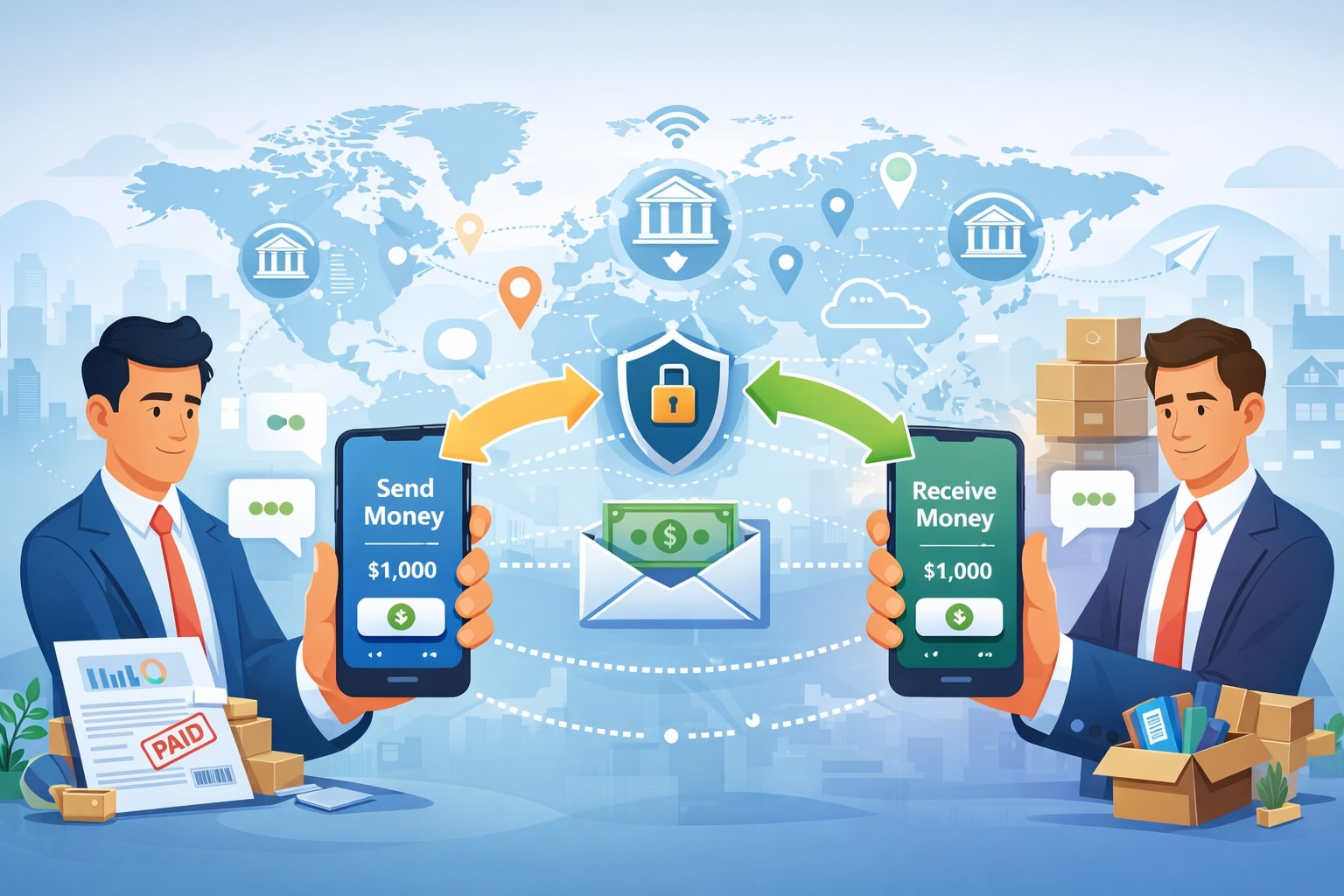
At a practical level, P2P payments for business work when one party initiates a digital transfer using an identifier (like a phone number, email, username, QR code, or payment link), the payment app or bank network routes the request, and funds settle into the recipient’s balance or bank account.
What makes P2P payments for business so attractive is the combination of convenience and speed—especially when compared to checks or slow bank transfers. But that speed comes with tradeoffs: platform rules, transaction limits, reporting and recordkeeping responsibilities, and disputes that don’t work like card chargebacks.
This guide explains how P2P payments for business work end-to-end: the rails behind the scenes, how popular tools handle fees and settlement, where businesses get stuck, and what to do to stay compliant and protected. You’ll also get practical setups, best practices, and forward-looking predictions so you can keep P2P payments for business efficient as the ecosystem evolves.
What “P2P Payments for Business” Means in Real Life

P2P payments for business are digital person-to-person style transfers used in a business context—meaning the payment is connected to goods, services, deposits, tips, reimbursements, or business-to-business settlements.
The defining feature isn’t the sender’s identity (a person can pay a business) but the user experience: the payer initiates a transfer using a simple identifier, and the recipient receives funds quickly without needing a traditional card checkout flow.
In the real world, P2P payments for business often fall into a few patterns. First is customer-to-business: a customer pays a service provider using a QR code, payment handle, or request link at the end of a job.
Second is business-to-person: a business pays workers, drivers, creators, or contractors quickly after a shift or project. Third is micro-B2B: small businesses pay each other for supplies, booth fees, referrals, or shared marketing.
It’s important to understand that P2P payments for business can happen through bank-based networks or app-based platforms. Bank-based tools (like bank-to-bank transfers routed through participating financial institutions) typically settle directly into a bank account.
App-based platforms may use an in-app balance first, then transfer to a bank later. This distinction matters because it impacts cash flow timing, fees for instant access, and what happens when a payment is reversed or disputed.
Finally, P2P payments for business are not automatically “business-grade” just because a business uses them. Many platforms have separate personal vs business profiles, different protections, and different fee schedules.
Using P2P payments for business correctly means choosing the right account type, labeling payments properly, and building a workflow that produces clean records.
The Step-by-Step Flow of How P2P Payments for Business Work
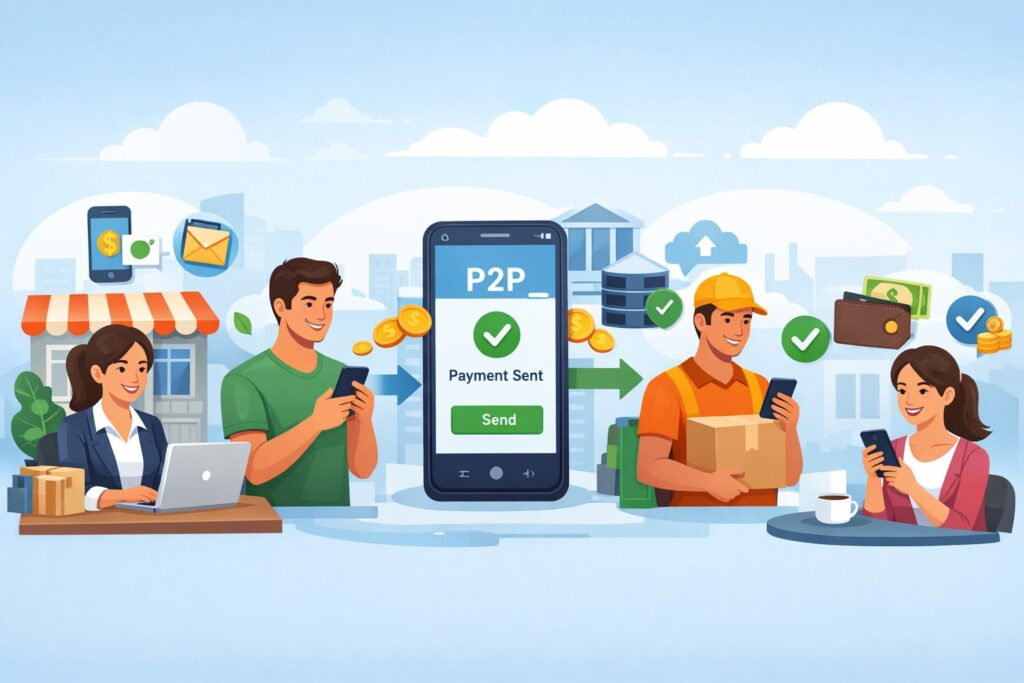
P2P payments for business may look simple on the surface—tap, send, done—but the underlying flow has several steps that determine speed, cost, and risk. Understanding this flow helps you avoid failed transfers, missing funds, or accounting confusion.
Step 1: Identity and “Addressing” the Payment
P2P payments for business start when the payer identifies the recipient using a proxy: phone number, email, username, or a QR code tied to one of those identifiers. Some bank-based services also use a “tag” or unique ID.
For example, Zelle’s small business experience supports sending and receiving using an email address, mobile number, or a Zelle tag, depending on the bank’s implementation.
This “addressing layer” is more important than it sounds. If a customer types the wrong handle, the payment can go to the wrong place. For P2P payments for business, you reduce errors by using QR codes, short links, and saved payees for repeat customers.
Step 2: Authorization and Funding Source
Next, the sender authorizes the transfer. Funding can come from a linked bank account, debit card, credit card, or an app balance. Each funding method affects fees and settlement speed. Some platforms charge a fee to the business on receipt; others charge for instant withdrawal; others apply fees when a card is used as the funding source.
For P2P payments for business, you want to know which funding sources your customers prefer—because that can change your net cost and how quickly you can access funds.
Step 3: Routing Through Networks or Platform Ledgers
After authorization, the payment is routed. Bank-integrated P2P often routes through bank rails and partnerships. App-based P2P may route through internal ledgers first (updating balances inside the app), then batch or push funds out to bank accounts later.
The key point: P2P payments for business don’t all use the same “rails.” Two payments that look identical to a customer can have very different backend behavior and risk.
Step 4: Settlement, Availability, and Withdrawal
Finally, the recipient sees funds. “Received” doesn’t always mean “available to spend in your bank account right now.” Some platforms make funds available instantly inside the app but charge for instant bank withdrawal. Others settle directly into a bank account quickly.
This is why P2P payments for business cash-flow planning matters. You should test your most common payment types end-to-end and document the exact timing in your SOP.
The Rails Behind P2P Payments for Business

To run P2P payments for business confidently, it helps to understand the main movement methods behind the scenes. You don’t need to be a payments engineer, but you should know the difference between bank settlement speed and platform balance updates, and what that means for reversals, disputes, and availability.
Bank-to-Bank Transfers and Faster Payments
Some P2P payments for business are closely tied to bank accounts and can settle quickly when both parties use participating financial institutions. Bank-led P2P can reduce dependency on keeping funds in an app wallet.
Zelle’s small business approach, for instance, is designed to work inside the bank’s own digital channels so funds land directly in the account, which can be attractive for bookkeeping and cash flow.
App-Ledger Transfers and “Wallet First” Models
Other P2P payments for business are driven by a platform that maintains balances for users. The platform credits the recipient’s wallet balance immediately, then lets them transfer out.
This can be fast and user-friendly, but it can also create operational questions: What if your account is flagged? What if a payment is reversed? What if a customer marks a transaction as unauthorized?
Card-Funded P2P and Fee Implications
Some P2P payments for business are funded via cards. That can increase convenience for customers, but it can also introduce additional fees or restrictions depending on the platform. The business should understand whether fees are paid by the sender or deducted from the business’s receipt, and what protections come with the funding method.
Why Rails Matter for Risk and Recordkeeping
Rails determine whether P2P payments for business behave more like “cash” (hard to reverse, minimal disputes) or more like “card” (more disputes, more consumer protections).
They also shape how your accounting system should tag and reconcile transactions. Businesses that treat all P2P payments for business the same often end up with messy books and avoidable losses.
Fees, Limits, and Availability: The Business Reality of P2P Payments
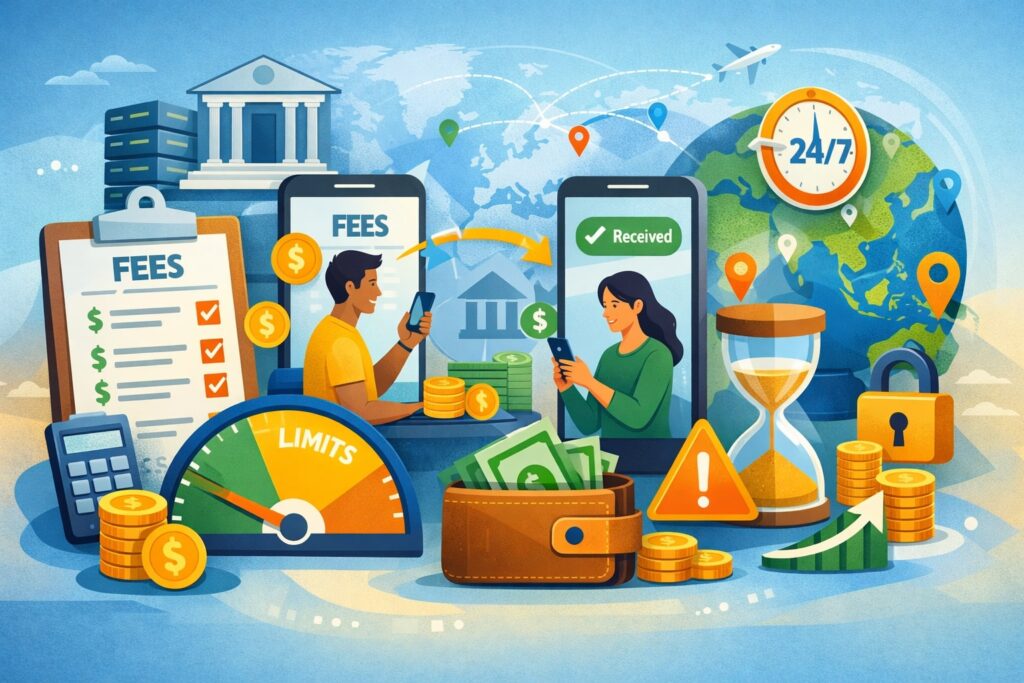
P2P payments for business can be cheaper than card processing in certain situations, but “cheap” isn’t the same as “free.” There are also limits that can disrupt cash flow if you don’t plan around them.
Common Fee Structures You’ll See
Many platforms monetize P2P payments for business through one or more of these mechanisms:
- Merchant receive fee (a percentage plus a fixed amount)
- Instant withdrawal fee (to move funds to your bank immediately)
- Card funding fees (sometimes paid by sender, sometimes waived or handled differently for business profiles)
For example, Cash App’s published business fee schedule states that business accounts are free to create, but it deducts a processing fee per payment received, including a listed 2.6% + $0.15 per transaction for standard payments into a Cash App Business account (and a separate fee for Tap to Pay).
Venmo’s business profile fees are documented in its help center, including the concept that fees are charged to the business profile for receiving payments, and that certain credit-card-related consumer fees can be treated differently when paying a business profile.
The lesson for P2P payments for business is simple: always verify the official fee page for the exact product you’re using, because personal, business, and “in-person” features may price differently.
Limits and Why They Matter
Limits are one of the most overlooked parts of P2P payments for business. Limits can apply per transaction, per day, per week, or per recipient. Some are based on account age, verification level, bank partner policies, risk scoring, or prior activity.
If your business relies on P2P payments for high-ticket invoices, you must test your maximum amounts before you make it your default method. Limits are especially important for seasonal businesses that suddenly receive a burst of high volume.
Funds Availability Isn’t Always the Same as Settlement
“Money received” may mean “available in app” but not “available in bank.” If you pay vendors or payroll from your bank account, then P2P payments for business that sit in a wallet can create friction unless you schedule withdrawals or use a platform that routes directly to bank deposit.
Picking the Right Use Cases for P2P Payments for Business
P2P payments for business shine when the business model matches the strengths of instant, simple transfers. They can struggle when you need sophisticated checkout, partial captures, recurring billing, complex refunds, or strong dispute management.
Best-Fit Scenarios
Field services and appointment businesses often do well with P2P payments for business because the payment moment happens right after service completion. A QR code on an invoice or phone screen closes the loop quickly.
Pop-up vendors and local sellers also benefit because they can accept payment without new hardware. P2P payments for business can reduce friction when a customer forgot cash and doesn’t want to type card details.
Contractors and creators use P2P payments for business to receive deposits, milestone payments, and tips. Speed helps cash flow, and the sender experience is familiar.
Scenarios Where You Should Be Careful
If your business needs chargeback-style dispute workflows, P2P payments for business might not be ideal because dispute processes can be inconsistent and platform-specific.
If you sell high-risk or regulated products, P2P payments for business may introduce account closure risk if the platform restricts your category. In those situations, businesses often prefer traditional merchant processing designed for their risk profile, then use P2P as a supplementary option.
If you require detailed invoice management and accounting integration, P2P payments for business can still work, but you must design your reconciliation workflow first.
A Practical Rule of Thumb
Use P2P payments for business for speed, convenience, and low setup friction. Use traditional merchant acceptance for structured checkout, broader payment acceptance, and mature dispute tooling. Many businesses blend both.
Setting Up P2P Payments for Business the Right Way
Most problems with P2P payments for business come from setup shortcuts: mixing personal and business transactions, failing to label payments, or skipping verification steps. A strong setup prevents tax confusion, reduces payment errors, and creates clean records.
Use a Business Profile When the Platform Offers One
If a platform distinguishes between personal and business profiles, use the business option for P2P payments for business. That helps align your activity with the platform’s terms and can unlock business features like receipts, reporting, and payment labels.
It also reduces the risk that your business activity looks like prohibited commercial use on a personal account. For P2P payments for business, compliance with platform policies is part of risk management.
Separate Business Banking and Personal Banking
Even when P2P payments for business arrive into a wallet, you should transfer them to a dedicated business bank account. Keeping separation makes bookkeeping cleaner and reduces the chance that personal transfers get mixed into business income reporting.
This matters more as reporting rules evolve. The IRS has published updated Form 1099-K FAQs, clarifying how reporting works for payments received for goods and services through payment settlement entities.
Build a Simple “Payment Reference” System
P2P payments for business can feel messy because customers often write vague notes (“thanks!”). Fix this by training customers and staff to include a reference format like:
- Invoice number
- Service date
- Last name + job ID
- Deposit label (“Deposit – Kitchen Remodel”)
Then standardize how you match that reference to your accounting entries.
Security, Fraud, and Dispute Handling in P2P Payments for Business
P2P payments for business are fast, and speed can amplify risk. The most common problems are misdirected payments, social engineering scams, account takeovers, and “friendly fraud” where someone claims a payment was unauthorized.
Reduce Misdirected Payments
For P2P payments for business, your best protection is preventing mistakes:
- Use QR codes rather than manually typed handles
- Display your payment name consistently across invoices, signage, and texts
- Confirm the recipient identity on the customer’s screen before they hit send
- For larger amounts, do a $1 test transfer first
Know What “Dispute” Means on Your Platform
Unlike cards, where chargebacks follow standardized network rules, P2P payments for business disputes can differ widely. Some platforms may reverse payments under certain fraud conditions. Others may treat them more like cash transfers once sent.
So your policy should be: treat P2P payments for business as final unless your platform explicitly provides reversals, and protect yourself with documentation (invoice, proof of delivery, signed work authorization).
Protect Your Account Access
Because P2P payments for business rely heavily on app access, account security is critical:
- Enable multi-factor authentication
- Use a password manager
- Limit admin access to trusted staff
- Avoid logging in on shared devices
- Monitor login alerts and device lists
If your account is compromised, you can lose funds quickly—and recovery isn’t guaranteed.
Taxes, Reporting, and Bookkeeping for P2P Payments for Business
Taxes are where P2P payments for business can get confusing, especially when businesses mix personal and commercial transfers or fail to categorize transactions.
Understanding Information Reporting
Payment platforms may issue Form 1099-K for payments received for goods and services when thresholds and rules apply. The IRS has published updated FAQs to help taxpayers understand what Form 1099-K is and when it’s triggered.
Media and tax publications have also highlighted that reporting thresholds have been changing and phased in. For instance, coverage around the 2024 tax year discussed a $5,000 threshold for goods and services reporting in that period.
Because thresholds and implementation can change, you should rely on IRS guidance and your tax professional for the current filing year’s rules.
Keep Personal Transfers Out of Business Flows
The cleanest approach for P2P payments for business is:
- One business profile
- One business bank account
- No personal reimbursements inside the same profile
- Clear memo/reference practices
This reduces the chance that personal transfers create accounting noise or misunderstanding later.
Bookkeeping Workflow That Actually Works
A practical workflow for P2P payments for business:
- Record each P2P receipt as income (or liability if deposit)
- Match it to an invoice/job/customer
- Record platform fees (if any) as payment processing expense
- Reconcile wallet-to-bank transfers as internal transfers, not income
- Store export reports or monthly statements from the platform
If you do this consistently, P2P payments for business become easy to reconcile—and much easier to explain to a tax preparer.
Optimizing Customer Experience with P2P Payments for Business
When businesses say “P2P doesn’t work for us,” the issue is often not the payment method—it’s how it’s presented. Customers need clarity, trust, and a frictionless path.
Make the Payment Choice Obvious
Use one primary call-to-action per invoice or message:
- “Pay by card”
- “Pay by bank transfer”
- “Pay with P2P payments for business (scan QR)”
When you overload customers with options, they stall. P2P payments for business work best when the path is simple.
Use QR Codes and Payment Links Everywhere
Add QR codes to:
- Printed invoices
- Job completion checklists
- Appointment confirmations
- SMS receipts
- In-store signage
QR reduces errors and makes P2P payments for businesses feel “tap-and-go.”
Set Expectations on Receipts and Refunds
If you offer refunds, explain how refunds work for P2P payments for business. Some businesses refund via the same platform. Others refund via bank transfer or check. Whatever you choose, write it down and make it consistent so customers feel safe paying you that way.
Future Predictions: Where P2P Payments for Business Are Headed
P2P payments for business are moving toward a more unified world where the line between “P2P,” “bank transfer,” and “merchant payment” blurs. Several trends are likely.
More Bank-Led Business Features
Bank-based P2P keeps expanding its small business focus. Zelle has publicly discussed small business capabilities and new SMB-related features as volumes grow, indicating ongoing product investment in business flows.
Expect deeper invoice references, better reconciliation outputs, and more “request for payment” style experiences inside banking apps.
Clearer Commercial Rules and Reporting
As tax authorities continue to refine guidance, P2P payments for business will likely see clearer standardization in how “goods and services” are tagged, how receipts are generated, and how users separate personal vs business activity. The IRS publishing revised FAQ documents is consistent with this direction.
More Embedded P2P Inside Business Software
The next wave is P2P payments for business embedded directly inside scheduling tools, invoicing apps, and lightweight POS systems.
Instead of telling a customer “send to this handle,” the software will generate a request, confirm payer identity, and automatically match the payment to the invoice. That reduces reconciliation time—one of the biggest current pain points.
Risk Controls Will Get Stricter
With growth comes fraud pressure. Expect more identity verification, more transaction monitoring, and more documentation requirements for higher volumes. Businesses using P2P payments for business should plan for occasional holds and build cash buffers.
FAQs
Q.1: Are P2P payments for business the same as card processing?
Answer: No. Card processing typically uses card networks, standardized dispute rules, and merchant category frameworks. P2P payments for business often use bank-linked services or app-ledger transfers.
That changes how disputes work, how refunds work, and what receipts look like. P2P payments for business can be easier to start with and faster for funds availability in some cases, but it may not replace card acceptance if you need broad payment options, advanced checkout, or standardized chargeback handling.
Q.2: Do P2P payments for business charge fees?
Answer: Often, yes—though the fee type varies. Some platforms charge a fee to receive payments on a business profile, some deduct a processing fee per transaction, and some charge for instant withdrawals.
For example, Cash App lists a processing fee for payments received by Cash App Business accounts (including a 2.6% + $0.15 fee structure on certain payments) and separate pricing for other acceptance methods. Always check the official pricing page for your specific product tier before committing.
Q.3: Can I use a personal P2P account for business payments?
Answer: Many platforms allow personal-to-person transfers but restrict commercial use on personal profiles. For P2P payments for business, using the business profile (when available) is safer and typically provides better recordkeeping features. It also reduces the risk of account limitations if your activity is flagged as commercial.
Q.4: Will I get a tax form for P2P payments for business?
Answer: You may, depending on rules for the filing year, transaction types, and thresholds. The IRS provides Form 1099-K guidance and FAQs explaining how reporting works for payments received for goods and services through payment settlement entities.
Even if you don’t receive a form, taxable income is generally still taxable. A clean separation between personal and business transactions is essential for P2P payments for business.
Q.5: Are P2P payments for business instant?
Answer: Sometimes. Some P2P payments for business settle quickly to bank accounts when using bank-integrated options. Others are instant inside the app but take longer (or cost extra) to move to your bank. “Instant” also doesn’t always mean “irreversible,” so you should understand your platform’s dispute and reversal policies.
Q.6: What’s the safest way to accept P2P payments for business from new customers?
Answer: Use QR codes, confirm payer details, and maintain documentation. For higher amounts, consider a small test payment first. Require invoice references in notes.
And don’t release high-value goods until you confirm the payment is actually received and available according to your platform’s rules. P2P payments for business can be safe, but only when you treat setup, documentation, and security as part of your payment workflow.
Conclusion
P2P payments for business work because they simplify how money moves: a payer uses an identifier, a platform or bank network routes the transaction, and funds become available quickly—often faster and with less friction than checks or manual bank transfers.
But the ease can hide important details: the rails behind the transfer, how fees are assessed, when funds are truly available, what limits apply, and how disputes or reversals are handled.
To get the most from P2P payments for business, treat them like a system—not a shortcut. Choose the right account type, separate personal and business flows, require consistent payment references, and build a bookkeeping routine that records fees and matches receipts to invoices. Stay aware of reporting guidance, such as IRS Form 1099-K FAQs for goods-and-services payments, and keep your documentation strong.
Looking ahead, P2P payments for business will likely become more “business-native,” with stronger bank-led tools, tighter security controls, and deeper software integrations that automate matching and reporting.
Businesses that set up P2P payments for business properly now will be in the best position to benefit from faster settlement, smoother customer experiences, and cleaner financial operations as the ecosystem matures.