
By Rinki Pandey December 28, 2025
P2P payments started as a simple way for people to split dinner or pay a friend back. But the same “send money in seconds” experience is now reshaping how modern companies collect funds, reimburse expenses, pay contractors, and move money between internal teams.
When you integrate P2P payments into business workflows, you reduce payment friction, shorten cash conversion cycles, and make the money movement experience feel as fast as the rest of your digital operations.
The challenge is that “P2P” can mean multiple things in business: consumer wallet transfers, bank-to-bank instant payments, alias-based transfers (phone/email), or app-based payments used for commerce.
Each option comes with different fees, settlement timing, data quality, reconciliation complexity, and fraud exposure. The win comes from designing an intentional system: matching the right P2P payments method to the right workflow, integrating it cleanly into your tools, and wrapping it with controls so it scales safely.
This guide walks through practical, real-world ways to integrate P2P payments into everyday operations—AR, AP, payroll-like payouts, reimbursements, and customer refunds—while keeping accounting clean and risk manageable.
You’ll also see what’s changing in instant payments and request-for-payment models, and how to future-proof your workflow design as real-time rails expand. For example, the RTP® network highlights high daily processing volumes and reliability as instant payments mature.
Understanding what “P2P payments” means in a business context

In business, P2P payments are less about “person-to-person” and more about “account-to-account with a consumer-grade experience.”
The defining traits are speed, simple recipient addressing (often phone/email), and a lightweight authorization experience compared to traditional invoicing or card acceptance. The tricky part is that there are at least three distinct categories you must separate before you design workflows:
First, there are wallet-based P2P payments apps that consumers already use. They’re popular with micro-merchants, service providers, and event vendors because customers are already familiar with them. However, these apps often have business-specific profiles, transaction fees, dispute nuances, and limits.
For example, widely referenced industry summaries cite business transaction fees and instant transfer fee structures that can materially affect your margins and cash flow planning.
Second, there are bank-led P2P payments that ride on bank transfer infrastructure with alias directories. These can be convenient for small businesses collecting from local customers or paying contractors quickly.
The experience can feel like consumer P2P, but operationally you must still treat it as a payment rail with limits, compliance requirements, and potential reversal or fraud disputes.
Third, there are instant account-to-account rails (real-time payments). These aren’t “P2P apps,” but they deliver the same speed and immediacy businesses want.
The most important shift here is that instant rails increasingly support higher-value business payments and new message types like request-for-payment (RfP), which is directly relevant to business workflows such as bill pay, collections, and settlement.
The RTP network has highlighted major increases in transaction limits over time, enabling larger instant transfers for businesses.
When you integrate P2P payments, you’re choosing a category (or multiple categories), defining where it fits in your operations, and then building controls around identity, authorization, payment confirmation, data capture, and accounting.
Where P2P payments create the biggest workflow wins

The best use cases for P2P payments are the ones where speed and convenience directly reduce operational workload. In practice, that usually means high-frequency, low-to-mid value transactions where your team currently spends time chasing confirmations, issuing checks, or reconciling messy transfers.
A common win is rapid reimbursement and expense payback. If your business has field staff, contractors, or distributed teams, reimbursements can become a morale issue when they take days.
Integrating P2P payments into your expense workflow can turn “submit receipt → get paid” into a same-day loop, reducing support tickets and improving retention for gig-style workers.
Another major win is customer refunds and goodwill credits. Card refunds can take days. Checks create cost and delay. P2P payments let you issue near-instant refunds for customer satisfaction moments—especially useful in service businesses where fast resolution prevents chargebacks or negative reviews.
The key is to ensure the refund process is tied to a verified identity and documented in your accounting system, so speed does not create “money leakage.”
You also see strong results in micro-invoicing and partial payments. If you run a service business—repairs, lessons, events, personal services—customers often prefer fast payment methods.
Integrating P2P payments into the “pay now” step can increase completion rates, especially when customers are paying from a phone. The conversion lift can be meaningful because you’re reducing the number of steps between intent and payment.
Finally, vendor and contractor payouts can benefit when your AP process is too slow for the pace of your operations. Rather than batching payments weekly, you can pay on completion milestones and improve vendor loyalty. This is especially useful for time-sensitive fulfillment networks where fast payout improves supply availability.
The thread across all these wins is that P2P payments reduce friction and time-to-money, but only if you design the workflow to capture payment metadata, confirm receipt, and reconcile automatically.
Mapping P2P payments to specific business workflows
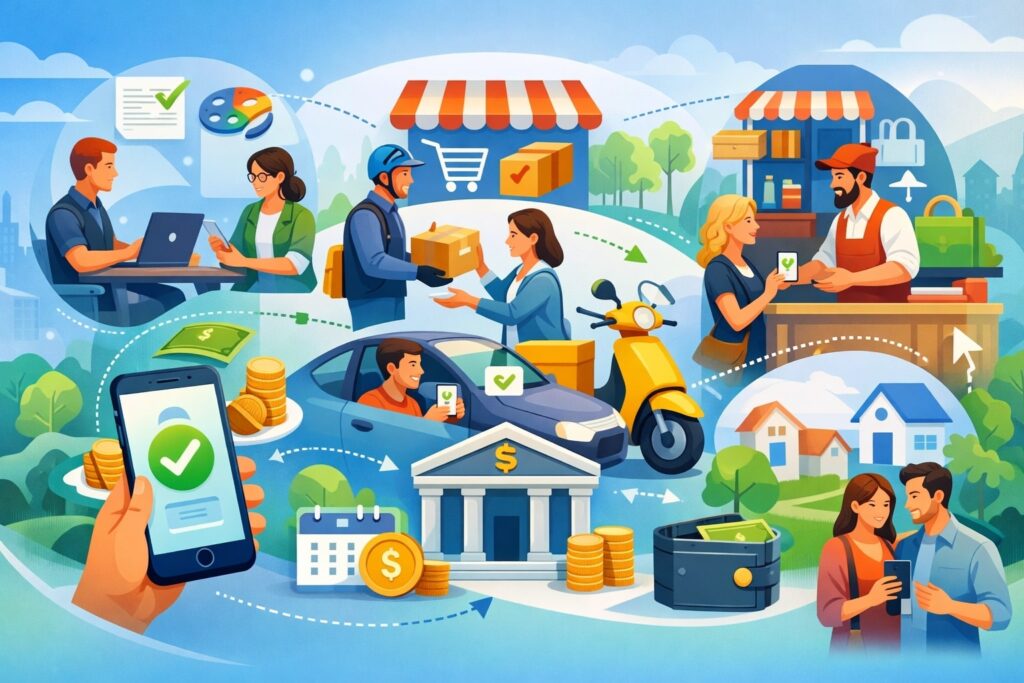
To integrate P2P payments successfully, you need a workflow map—not just a payment button. The same payment method that works for customer collection might be wrong for payroll-like payouts. Below are the most common workflow categories and how to think about each.
P2P payments for collections and accounts receivable (AR)
Using P2P payments for AR works best when invoices are simple, the payer base is broad, and speed matters more than deep remittance data.
Examples include service invoices, deposits, appointment fees, and small-balance outstanding invoices. The advantage is that the payer experience is simple: they can pay from a familiar interface or from their banking app without typing card details.
The operational risk is data quality. If your P2P inflows don’t carry invoice identifiers, you’ll spend time matching payments manually. The fix is to build a payment request flow that embeds identifiers in the memo field, QR code, or payment link experience, and then enforce a “no memo, no credit” policy for certain invoice types.
In practice, you can provide customers a prefilled payment request message that includes an invoice number format you can parse automatically.
You should also decide how to handle partial payments. P2P payments can make partial payments more common (“I’ll pay half now”). That can be good for collections, but you need a rule: do you allocate to oldest invoices first, specific invoice IDs, or a customer balance? Put this into your workflow logic so it doesn’t become an accounting debate later.
P2P payments for payouts, reimbursements, and contractor pay
For payouts, P2P payments need stronger identity assurance and controls than AR. You’re pushing funds out, which is where fraud attempts concentrate.
Your workflow should require recipient verification steps (such as confirming a phone/email alias, confirming last four digits of a bank account where appropriate, or using a verified profile) and must log authorization.
Operationally, payouts benefit from tiering. For example:
- Low-risk reimbursements: fast payout after basic verification
- Higher-risk payouts (new recipients): delayed or stepped verification
- High-value payouts: multi-approval and additional checks
Also define what happens when a payout fails. Does your system automatically retry? Does it fall back to ACH? Do you notify the recipient to correct details? These “exception paths” are where money gets stuck and support tickets spike, so design them as first-class workflow steps.
Choosing the right P2P payments options and rails
Picking a P2P payments method is not a branding decision—it’s an operating model decision. You’re choosing fees, limits, settlement speed, dispute paths, and data payload quality.
Wallet-based P2P payments for commerce acceptance
Wallet-based P2P payments can be attractive because customers already have them installed and trust them. But you must understand the business profile rules and fees. Industry summaries commonly cite business transaction fees (for receiving payments) and instant transfer fees that impact margins, especially for high-frequency merchants.
This category is often best for:
- Solo operators and service providers
- Event vendors and pop-up sellers
- Small tickets where convenience drives conversion
- Refund scenarios where speed improves satisfaction
However, it’s usually not ideal as your only rail once volume grows. Fees can be higher than bank transfer methods, and reconciliation may be weaker unless you build strong internal tagging and reporting.
Bank-led P2P payments and business limits
Bank-based P2P payments can be excellent for business-to-consumer (B2C) style flows—refunds, rebates, reimbursements—because recipients often only need an alias. But limits matter.
Many businesses run into caps that complicate scaling, and limits can vary by bank and customer profile. Business users should plan for variability and build fallbacks.
The best practice is to design a rules engine:
- If payment amount ≤ X and recipient verified → use P2P
- If payment amount > X or recipient new → fallback to ACH / other
- If the recipient’s bank doesn’t support your preferred method → alternate payout
This avoids operational surprises and keeps customer expectations realistic.
Instant account-to-account rails and why they matter to P2P payments strategy
Even if your business thinks in “P2P apps,” your long-term strategy should also consider instant bank rails because they are increasingly used for the same outcomes: immediate availability and modern messaging.
The RTP® network emphasizes its mature instant payment infrastructure and reliability, and industry coverage has highlighted the growth in higher-value instant transactions over time.
Separately, the FedNow Service has continued to expand use cases and adoption since launch, including public-sector disbursement programs that signal broader instant payout momentum.
From a workflow perspective, instant rails help you:
- Offer “instant available” payouts without wallet dependency
- Reduce float time on refunds and claims
- Support request-for-payment (where available) for cleaner AR flows
- Improve predictability compared with card settlement timing
Integration architecture: how to embed P2P payments into your tools
Integrating P2P payments into business workflows should be treated like any other production financial integration: defined events, structured data, logging, security, monitoring, and reconciliation. The biggest mistake is to “bolt on” P2P payments as a manual side-channel. That works for a few transactions, then becomes chaos when you scale.
Start by deciding where P2P payment actions live:
- In your CRM (customer-level collection)
- In your invoicing system (invoice-level collection)
- In your payroll/contractor tool (payout)
- In your expense tool (reimbursement)
- In your customer support tool (refund/goodwill credit)
Then define key workflow events, such as:
- Payment requested
- Payment initiated
- Payment confirmed / received
- Payment failed / expired
- Payment reversed / disputed
- Funds transferred to bank (if wallet-based)
Each event should generate a record with consistent fields: payer/payee identifier, transaction reference, amount, fee, timestamp, workflow ID (invoice number, case ID, expense report ID), and status. This is what makes P2P payments “integrated” instead of “miscellaneous.”
Security must be built early. Use least-privilege access for API keys, lock down admin roles, and separate environments (test vs production). If you handle sensitive data, encrypt it properly and restrict internal visibility.
Also plan your monitoring: failed transactions, unusual velocity, mismatched names, or repeated alias changes are red flags that deserve alerts.
Finally, design for fallbacks. Even the best P2P payments methods have coverage gaps: some recipients can’t receive, some transfers fail, and some transactions hit limits. Build an automatic alternative rail (like standard bank transfer) and a user-friendly “fix your details” loop.
Reconciliation and accounting: making P2P payments auditable
A business can’t scale P2P payments without clean reconciliation. The core challenge is that P2P transfers often arrive with inconsistent remittance details, and staff may be tempted to treat them as “informal money movement.” That’s where books get messy.
Your reconciliation design should include three layers:
1) A unique internal reference: Every payment—incoming or outgoing—must tie back to one internal object: invoice, order, claim, refund case, expense report, vendor bill, or payroll batch. That internal reference should be included in the payment metadata wherever possible (memo, note, payment request text). Even if customers omit it sometimes, your workflow should encourage it heavily.
2) Automated matching rules: Build matching rules that use:
- Amount tolerance (exact match or within a small variance)
- Counterparty identifier (phone/email or account token)
- Timestamp window (payment received within 48 hours of request)
- Invoice/customer mapping
This can reduce manual work dramatically and makes P2P payments viable beyond a small team.
3) Exception handling with a tight loop: For unmatched payments, route them into a queue with a defined SLA and resolution steps. Examples:
- Request missing invoice ID from payer
- Apply to customer balance and notify
- Hold funds until clarified (with policy language)
Also account for fees properly. Wallet-based P2P payments models may charge per transaction; instant transfer fees may apply if you move balances to your bank quickly. Capture fees as separate ledger entries so your gross vs net reporting remains accurate.
The end goal is simple: at any point, you should be able to answer, “What was this payment for?” and “Where is it in the ledger?” without hunting through screenshots.
Risk, fraud, and compliance controls for P2P payments
Speed is the biggest advantage of P2P payments—and also the biggest risk. Faster settlement reduces the time you have to detect fraud before funds move. So your workflow needs layered defenses that don’t ruin the customer experience.
Start with identity assurance. For inbound payments, confirm the payer identity where feasible (account login, verified email, known phone, customer history). For outbound payments, confirm the recipient identity more rigorously. New payees deserve stricter checks: name consistency, alias confirmation, and a second factor for changes.
Next, implement velocity and anomaly controls. Examples:
- Limit number of payouts per day per staff user
- Block unusually high refund volume to new recipients
- Flag repeated alias changes
- Require approval for payments over thresholds
Then address social engineering, which is common in P2P environments. Train your team on “urgent payout” scams, fake vendor changes, and impersonation. Require written verification steps for changes to payout details—especially for vendors.
On the policy side, make sure your terms and internal SOPs define:
- When P2P payments are allowed
- Which workflows can use P2P payments
- Who can approve exceptions
- How disputes are handled
- How customer support verifies requests
Finally, keep an eye on evolving consumer protection and fraud discussions around P2P apps, because expectations about liability and protections can change.
Recent commentary has pointed to proposed measures and state-level initiatives aimed at improving security requirements for financial apps, reflecting broader momentum around P2P fraud prevention.
When your controls are built into the workflow—not layered on as manual steps—P2P payments can be fast and safe.
Customer and employee experience: making P2P payments feel seamless
A smooth experience is the reason you integrate P2P payments in the first place. But “smooth” doesn’t mean “anything goes.” The highest-performing implementations set expectations clearly and guide users through a consistent flow.
For customers, your payment UI should answer:
- What payment options are available?
- Is there a fee to use this method?
- When will funds be available?
- What information must be included (invoice number, order ID)?
- What happens if the payment is sent from the wrong account?
Use short, scannable instructions. Keep paragraphs brief. Avoid long blocks of text. Provide copy-paste payment notes that include the exact identifier format you want. If you can generate a QR code or a deep link into a payment experience (where your provider supports it), do it—less typing means fewer errors.
For employees and contractors, payouts must feel reliable. If you say “instant,” make sure the majority of payouts are actually instant, or explain the conditions. For example, new recipients may take longer due to verification. That’s okay if communicated clearly.
Also build a self-service update path. Let recipients update their details securely, but require verification and audit logs. Every time you remove back-and-forth from support, P2P payments become more scalable.
Most importantly, don’t force one method for everyone. Offer a primary method and one fallback. Your workflow should be chosen intelligently, while the user experience stays consistent.
Measuring ROI: KPIs that prove P2P payments is working
If you can’t measure it, you can’t scale it. The most valuable P2P payments metrics tie directly to operational outcomes: faster cash, fewer tickets, lower losses, and higher completion rates.
Track these core KPIs:
- Time-to-funds availability: Measure the median and 90th percentile time from “payment initiated” to “funds usable.” Split by method. This is the headline benefit of P2P payments, so it should be visible.
- Payment completion rate: For collections, measure how many payment requests convert within 24 hours, 72 hours, and 7 days. Compare P2P vs card vs invoice/ACH. If P2P payments lifts conversion, you’ll see it here.
- Support contact rate per 1,000 transactions: Every payment method creates confusion points. Track ticket drivers: wrong memo, wrong recipient, failed transfer, refund status, payout verification. Use this to refine UX.
- Reconciliation match rate: What percentage of transactions auto-match to invoices/cases without human work? This is the scaling metric. If your match rate is low, improve metadata capture and matching rules.
- Fraud and loss rate: Track loss per transaction volume, plus attempted fraud patterns (blocked events). If you integrate P2P payments into payouts, this metric is non-negotiable.
When you monitor these KPIs monthly, you can decide where to expand usage, where to tighten controls, and where to switch rails for better data and reliability.
Future prediction: where P2P payments is heading for business workflows
The next phase of P2P payments in business is about turning “instant transfers” into “instant workflows.” Two trends drive this: more widespread instant bank rails, and richer messaging that ties payments to business context.
First, instant payment adoption continues to expand, and infrastructure operators are actively positioning instant rails for broader business use cases.
The FedNow Service has highlighted ongoing growth and innovation milestones, suggesting continuing expansion of capabilities and participation. The RTP network continues to emphasize reliability and large-scale usage, with broader attention on higher-value instant payment capability.
Second, request-for-payment (RfP) is a major shift for AR. Instead of sending an invoice and hoping the payer initiates a payment, businesses can send a structured payment request that the payer approves.
This can dramatically improve remittance accuracy and reduce manual reconciliation. Industry announcements show ongoing development and validation of alias-based bill pay and RfP-related solutions on real-time rails, signaling continued innovation in how payments are initiated and linked to billers.
Third, risk controls will become more standardized. As P2P fraud patterns grow, more security expectations—stronger authentication, better scam detection, improved consumer safeguards—will pressure platforms and providers to harden flows. That’s good for businesses, because it reduces uncertainty and makes P2P payments safer as a default option.
The practical prediction: businesses that treat P2P payments as a workflow layer (not just a payment channel) will win. The winners will integrate identity verification, messaging, reconciliation, and fallbacks so tightly that “pay” becomes a simple action inside any operational step—refund, reimburse, settle, collect—without manual effort.
FAQs
Q.1: What is the safest way to use P2P payments for business payouts?
Answer: The safest approach is to integrate P2P payments with strong recipient verification, tiered limits, and audit trails. Start by verifying the recipient identity using more than one factor: confirmed phone/email, known history, and a verified profile or account token where available.
Then add payout rules: new recipients get lower limits or extra approvals; high-value payouts require multi-approval; changes to payout details trigger verification. Also build anomaly controls such as velocity limits and alerts on repeated alias changes.
Finally, log every payout event—who initiated it, who approved it, and what internal case it was tied to—so the payment is traceable in accounting and operations. When these controls are built into the workflow, P2P payments can be fast without becoming a fraud magnet.
Q.2: Do P2P payments work well for invoices and AR, or is it better for refunds?
Answer: P2P payments can work for both, but AR success depends on remittance data discipline. For refunds, you control the flow: you choose the recipient, amount, and internal reference, and you can document the refund case.
For invoices, you rely on the payer to include identifiers, which is where reconciliation can break. The best AR implementations use prefilled payment instructions, consistent memo formats, and automated matching rules to connect incoming P2P payments to invoices.
If you also offer a request-for-payment style experience where available, you can improve accuracy because the payment is initiated from a structured request. Over time, AR will benefit more as instant payment messaging improves, but refunds remain the easiest high-impact workflow to start with.
Q.3: How do fees typically compare when integrating P2P payments?
Answer: Fees depend on the category of P2P payments you use. Wallet-based commerce payments often have per-transaction receiving fees, and there may be additional fees for instant transfers to move balances into your bank quickly.
Bank-based and instant rails may price differently and can reduce certain fee types, but you still need to account for provider costs, implementation overhead, and operational savings.
The best way to compare is to calculate total cost per successful transaction, including staff time for reconciliation and support. Many businesses find that slightly higher per-transaction fees can still be worth it if P2P payments reduce failed payments, speeds cash, and cuts manual back-office work.
Q.4: What’s the biggest operational mistake businesses make with P2P payments?
Answer: The biggest mistake is treating P2P payments as an informal side channel instead of a real payment system. That usually looks like staff sharing handles or phone numbers, accepting payments without invoice references, and then manually “figuring it out later.”
This breaks reconciliation, creates tax and reporting issues, increases fraud exposure, and makes customer service harder. The fix is to integrate P2P payments into workflows with structured events, required metadata, and automated matching.
If a payment can’t be tied to an internal object (invoice, order, case, expense report), it shouldn’t be considered “complete” until it is.
Q.5: What should I build first when integrating P2P payments into workflows?
Answer: Start with one workflow where speed has obvious value and where you control most variables—usually refunds, reimbursements, or simple contractor payouts. These are easier to instrument and reconcile because you initiate the payment and can attach it to an internal case.
Build the full loop: request → verify → send → confirm → reconcile → report. Then expand into collections (AR) once your metadata and matching rules are proven.
This staged approach lets you capture the benefits of P2P payments quickly without creating accounting chaos. It also gives you time to refine controls before you use P2P payments in higher-risk, higher-volume workflows.
Conclusion
Integrating P2P payments into business workflows is no longer a novelty—it’s a competitive advantage when done correctly. The real value isn’t just speed; it’s the ability to move money in the same fluid, automated way you move information.
That means embedding P2P payments into the systems your teams already use, designing consistent events and records, and ensuring every transaction is tied to a business object that accounting can recognize.
A scalable approach starts with the right match between rail and workflow: use P2P payments where convenience and immediacy reduce friction, but pair it with identity controls, reconciliation automation, and fallback rails for coverage gaps.
Pay special attention to payout workflows because outbound payments attract fraud pressure. Build tiered approvals, velocity controls, and clear policies so speed doesn’t become a liability.
Looking ahead, instant rails and request-for-payment models will push P2P payments-style experiences deeper into core business operations, improving remittance data and reducing manual reconciliation.
With ongoing expansion in real-time payment ecosystems and continued innovation milestones on instant payment networks, workflow-first payment design will become the standard.