By Charles West December 27, 2025
One of the most significant decisions a small business has to make is payment acceptance. It affects cash flow, customer trust, efficiency of operations, and the company’s growth in the long run. The rapid growth of digital wallets and mobile transfers has led many entrepreneurs to a dilemma to choose between P2P payments vs card payments.
Payment apps offer peer-to-peer transactions with a promise of speed and ease of use, while credit cards provide a structured environment, scalability, and wide acceptance. Both payment methods are popular nowadays, but they target completely different business cases. A wrong selection can cause compliance problems, bookkeeping difficulties, or sales not made.
This guide provides a detailed comparison of P2P payments vs card payments from the viewpoint of small businesses. It will also aid the owners to pick the option that is based on the right factors like cost, customer behaviour, risk, and growth strategy – without making the decision unnecessarily complicated.
P2P Payments vs Card Payments: How Each Payment Method Works
Prior to evaluating advantages, it is imperative to discern the operational distinction between P2P and card payments. P2P payment system permits the movement of money straight between two persons through a mobile application that is linked either to their bank accounts or to the balance of their stored funds. Zelle, Venmo, Cash App, and PayPal have been the usual suspects for payments. But, now even small businesses accept payments from customers through them for their instant and hassle-free nature. The absence of a traditional merchant account is a plus that eliminates the onboarding hurdle.
On the other hand, card payments function through a taxed ecosystem of merchant payment processing consisting of several stages. A customer’s debit or credit card goes through card networks, issuing banks, acquiring banks, and payment processors. Although the system is quite complicated, it can handle massive transaction volumes, keep proper records, and meet regulatory requirements.
The above-mentioned basic distinctions are the reasons why each option is suitable for different small business payment methods and why the two cannot be compared in terms of superiority.
P2P Payments vs Card Payments: Cost, Fees, and Cash Flow Impact
Cost is often the primary concern for business owners when comparing P2P payments vs card payments. The P2P platforms normally promote standard transfers with low or no fees at all. This is the reason why they are preferred for small businesses that operate on a very low-profit basis or do few transactions. Some apps charge for instant deposits, but usually, standard transfers are free.
Credit card payments come with processing fees, which are usually between 2% and 3% per transaction, plus possible monthly or gateway fees. Even if these costs appear to be higher, they do include a lot of services such as fraud prevention, dispute handling, secure infrastructure, and financial reporting.
If a business looks at cash flow as an issue, P2P payments will freeze instantly or remain blocked for a few hours, while card payments will be released after one to three working days. However, card settlements are clear and can be verified, which is very important for businesses that have to manage payroll, taxes, and supplier payments within professional merchant payment processing systems.
P2P Payments vs Card Payments: Customer Experience and Buying Behaviour
The consumers’ wants have a significant impact on the choice between P2P payments vs card payments. Mobile customers who apply to P2P payments demand fast and seamless transactions the most. P2P is the most preferred payment method for local services, casual transactions, and interactions among peers. For the younger age group, scanning a QR code or sending money through an app is quite normal.
But card payments are still the usual expectation in most retail, online, and service settings. Customers link card acceptance with the concepts of legitimacy, security, and professionalism. Additionally, the rewards, purchase protection, and dispute rights lead many consumers to choose cards over other payment methods.
If small enterprises confine their payment choices to one, they will probably lose customers. Providing both methods often results in the best experience, which is in line with the modern digital payment solutions for small businesses that have flexibility as their priority.
P2P Payments vs Card Payments: Security, Fraud, and Risk Management
One of the most significant distinctions between P2P payments vs card payments is risk exposure. P2P scam payments are generally non-reversible after they have been executed. In case a client transfers money to the wrong account or later disputes the service, the options for resolution are very few. Very little fraud protection is available, and many businesses hold users accountable instead of the provider.
On the other hand, card payments expose to fraud to a higher degree but at the same time come with stronger protection mechanisms. Chargebacks, the means used to monitor fraud, and the high standard of encryption are all part of credit card networks. Although chargebacks may be expensive, they also contribute to the establishment of consumer trust, which in turn benefits sales in the long run.
For companies that deal with higher-value transactions or online payments, the card-based merchant payment processing is a lot safer and more structured environment.
P2P Payments vs Card Payments: Compliance, Taxes, and Record-Keeping
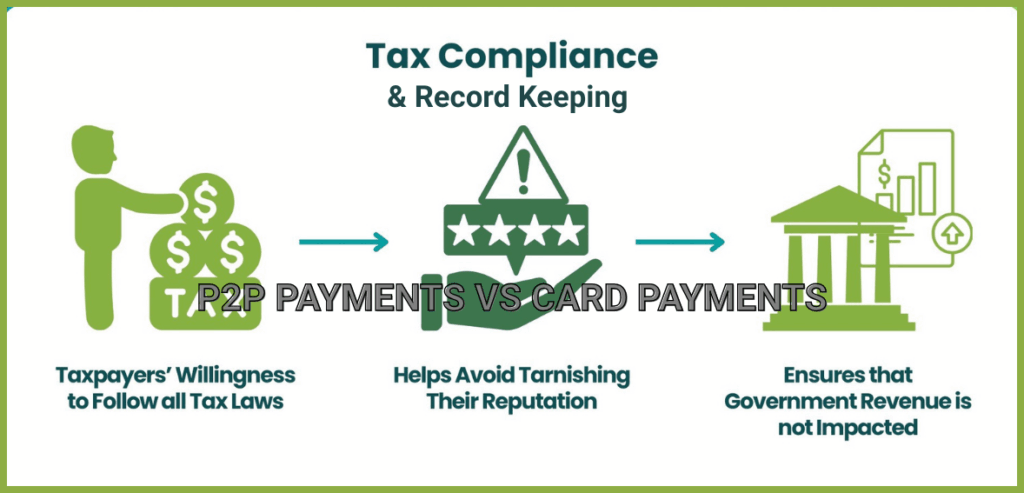
Compliance is the major area of divergence between P2P payments vs card payments. P2P service providers usually offer very basic transaction classification and reporting. Hence, the taxing, monitoring of revenues, and audits may get complicated. The companies might have to do payment reconciliations manually, which can cause errors or underreporting to occur rather easily.
Card payment methods create and provide the whole set of transaction records, sales reports, and tax-supporting documents automatically. The majority of them work in tandem with accounting software, which makes administrative tasks easier and more accurate.
Long-term growth businesses would need solid compliance support. This is one of the reasons why card payments are regarded as a reliable payment method for small businesses.
P2P Payments vs Card Payments: Scalability and Business Growth
Scalability stands out as the crucial difference between the two payment methods, i.e., P2P payments vs card payments. Low transaction volumes are the situations when P2P payments are most suitable for individual operators, freelancers, and side businesses. Constraints show up as sales increase: transaction caps, account freezes, and a lack of advanced tools.
On the other hand, card payments grow without any problems. They can accommodate recurring billing, subscriptions, and expansion of the e-commerce sector, in addition to supporting multi-location businesses. Card infrastructure links with inventory systems, CRM platforms, and analytics tools, thus being suitable for operations that are growing.
Businesses that are looking to grow either regionally or nationally will have to turn to card-based digital payment solutions for small businesses, as these will support growth without causing operational friction.
P2P Payments vs Card Payments: Best Use Cases for Small Businesses
When it comes to deciding between P2P payments vs card payments, it is necessary to extensively analyze the operation mode and the location of the business. On top of that, customer expectations and transaction value play an important role in this decision. P2P payments are most suitable for low-risk, relationship-driven situations where documentation is less important than speed and simplicity. Such businesses are those that emphasize instant settlements and minimal set-up as opposed to advanced reporting tools or dispute management.
P2P payments are suitable for:
- Local service providers.
- One-on-one transactions.
- Informal or appointment-based services.
- Quick settlements without invoicing.
On the other hand, card payments are more appropriate for:
- Retail and restaurants.
- Online stores.
- Professional services.
- High-volume or repeat transactions.
Most small businesses that are very successful tend to adopt a hybrid model whereby they use P2P for convenience and cards for structure within their overall merchant payment processing strategy. This way, they ensure flexibility without sacrificing professionalism or scalability.
P2P Payments vs Card Payments: Impact on Accounting, Reconciliation, and Financial Control
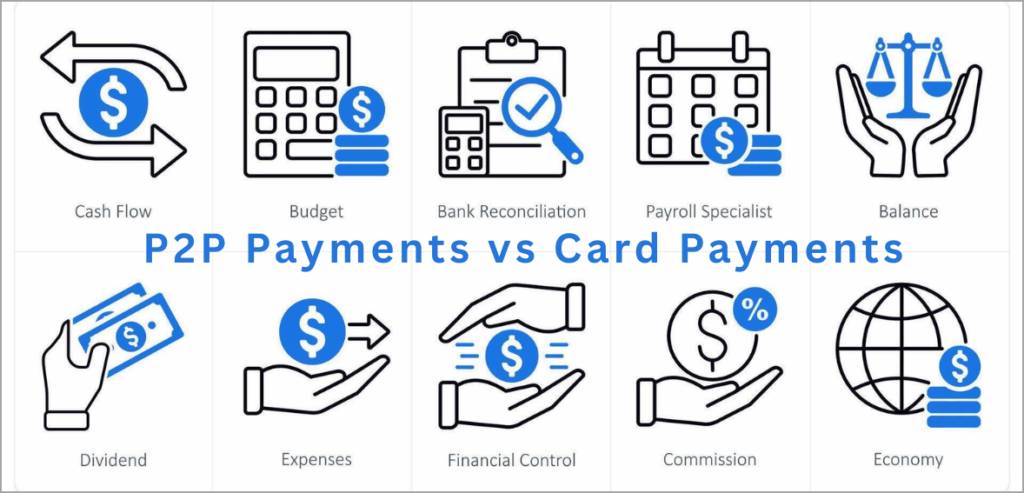
The decision between P2P payments vs card payments directly affects small businesses’ revenue tracking, accounts reconciliation, and financial accuracy maintenance. Payment methods lacking structured reporting usually entail hidden administrative work, and this becomes especially true when the volume of transactions goes up. Consequently, monthly closes get postponed, achieving tax filing becomes complicated, and the risk of errors increases.
The accounting treatment of P2P payments for merchants typically consists of:
- Tracking transactions manually across several applications.
- Income and expenses are being classified to a limited extent.
- Reconciliation is being done largely through spreadsheets.
On the other hand, card payment processing ensures that:
- Sales and settlement reports are generated automatically.
- Accounting software gets direct integration.
- Tax and compliance purposes are catered to through clear audit trails.
For businesses that place a strong emphasis on the long-term control of finances and clarity in operations, the processing of card-based merchant payments provides much stronger support, while P2P payments are best used for convenience-driven transactions only.
Conclusion
The discussion concerning P2P payments vs card payments is not a matter of selecting one and rejecting the other. It is a matter of collective payment methods against business objectives, customer expectations, and operational readiness.
P2P payments come with the advantages of speed, ease of use, and low initial investment. On the opposite side, card payments come with the advantages of trust, compliance, scalability, and stability in the long run. Companies that grasp these trade-offs are not only making smarter decisions but also avoiding costly mistakes.
For the most part, modern businesses are of the opinion that the right way is to be flexible, offering both options as part of the complete small business payment methods. This would mean providing convenience to the customers now while at the same time laying down a solid ground for future growth.
FAQs
What is the main difference between P2P payments vs card payments?
P2P payments are a straight transfer of money between two bank accounts, while credit card payments are an indirect transfer through the merchant processing systems that are equipped with security, compliance, and scalability features.
Are P2P payments allowed for small businesses, in legal terms?
Although it varies according to the guidelines set for each platform. It is advisable for businesses to first find out if the platform allows commercial use and then make sure that the transaction is reported accurately.
Which is cheaper: P2P payments vs card payments?
P2P payments generally have lower transaction fees, while card payments provide the security, reporting, and fraud protection, which can be regarded as an extra cost.
Do customers trust card payments more than P2P payments?
Yes, the transactions made through a card are recognized as safer and more official. This is the reason why they are more preferred in case the transaction is large or it is an online purchase.
Would it be a good idea for small businesses to accept both payment types?
Without a doubt, having both P2P and card payment methods will not only enhance your customer service but also impart the ease, convenience, and long-term growth potential of your company.